

Six insights from the frontlines of the industry's biggest appraisal format change in decades.
We sent Will Salus, our Head of Product, to the UAD 3.6 Bootcamp in Chicago to listen, share and learn with the appraisers, lenders, and AMCs who are navigating this change in real time. Here's what we found out.
.png?width=900&height=158&name=UAD%203.6%20Banner%20(2).png)
The mood in the room wasn't what you'd expect
The online conversation around UAD 3.6 would have you believe the industry is in panic mode. It isn't.
What we found in Chicago was something more interesting: genuine curiosity and a clear appetite to get on with it.
Appraisers who showed up to the bootcamp were there to learn, test, and prepare. The dominant question in the room had shifted from "what is UAD 3.6?" to something far more practical: "How do we run this in production without disrupting our business?"
The industry has moved through understanding and toward readiness and the appraisers who are going to come out ahead of November's mandate are the ones already getting reps in now. That energy isn't isolated to Chicago.
From different appraisal conferences to virtual sessions happening across the industry this year, there's a broader moment happening right now. UAD 3.6 is a compliance change, yes, but it's also opening the door for a new generation of tools and players that simply didn't have a place in the old ecosystem. The bootcamp was one lens on that. The wider industry is confirming it.
Three things that became clear quickly
1. Hands-on production beats theory every time
Running real orders through UAD 3.6 workflows is what exposes the true gaps in training, in tooling, and in expectations. Bootcamp sessions confirmed that the appraisers making the fastest progress were the ones who had already put live orders through the system, not just studied the spec.
2. Expect elevated time-to-complete early on
This isn't a failure, it's just the learning curve. Every appraiser who has moved into 3.6 production is seeing it take longer, initially. Workflow efficiency needs to be treated as a first-class objective as adoption ramps, not an afterthought. Tools that help appraisers get faster will define who thrives post-mandate.
3. Dual-track operations are a real operational challenge
For a period, 2.6 and 3.6 will co-exist. Appraisers are asking how to manage both without dropping the ball on either and how to serve GSE, non-GSE, and consumer direct volume across both formats post-mandate. This is one of the least-discussed and most practically important challenges right now.
The tech landscape is taking shape
Software vendors are gaining traction. GSE approvals are coming through, giving appraisers real options to evaluate and choose between. Each platform has its own approach and style, which means appraisers will increasingly make preference-based decisions not just availability-based ones.
Mobile scanning and data collection are shaping up to be foundational to the 3.6 ecosystem. The ability to capture and structure property data efficiently in the field isn't a nice-to-have, it's where efficiency and time savings live.
Lender portals, LOS systems, and review processes are being finalized now. The expectation across the bootcamp was that production will ramp meaningfully in July ahead of November's mandate. That's the window where experience and improvement will happen and where the appraisers and firms who are already in the system will pull ahead.
What this means for AI
UAD 3.6 opens real doors for improved analytics and AI-assisted workflows. But the message from practitioners was clear: appraisers need to understand AI's capabilities and its shortcomings. The value is in combining AI tools with appraiser judgement and field experience not replacing one with the other.
What Opteon brought to Chicago
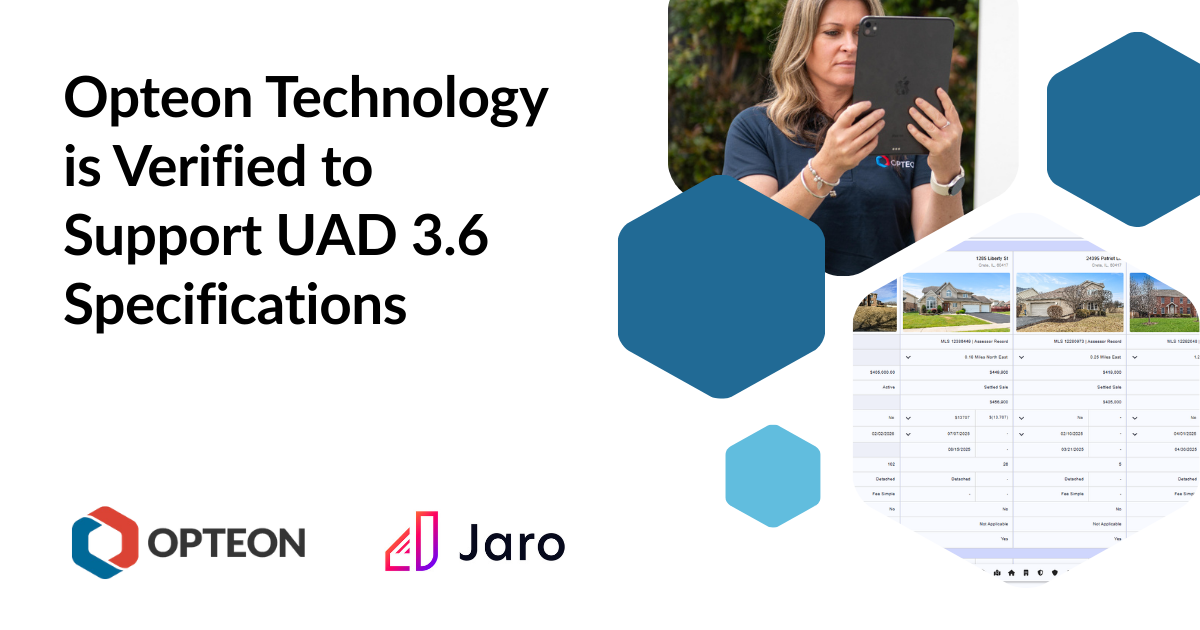
Opteon attended the UAD 3.6 Bootcamp primarily to showcase JaroKit and JaroInspect, the GSE-verified appraisal software currently supporting Opteon’s Appraisal team to deliver UAD 3.6 in production. Real orders are being completed and worked through the system right now.
We were also able to present 2.6 and 3.6 side-by-side reports, giving apple-to-apple comparisons that provide lenders and underwriting teams a concrete, grounded way to understand what changes and what stays the same. That kind of practical artefact turns abstract compliance into something teams can actually learn from.
The formula is simple: technology built for 3.6, paired with trained workflows, integrated delivery, and genuine readiness resources. That combination is what makes the difference between a smooth transition and a disruptive one.
Our approach to 3.6 readiness
Educate. Enable. Execute.
The firms navigating this transition best aren't waiting for November. They're building experience now, one order at a time. We're here to support every stage of that journey.






.png)
%20(1).png)