
-1.png?width=2000&name=SPECIALIST%20FOCUS%20SERIES%20TEMPLATE%20FULL%20IMAGE%20%20(1)-1.png)
Duane Gilliland
Senior Director, National Retail
A homemaker centre is not what most investors picture when they think about a 6% yield, yet large format retail - the bulky goods precincts and homemaker centres that line Australia's arterial roads - now account for more than 25% of all retail sales nationally, are attracting institutional capital at a pace not seen in years, and are sitting on a supply constraint that shows no sign of easing.¹
The sector accounts for an estimated $105 billion in annual sales to June 2025,¹ and commands more than 35% of all retail floor space nationally. ¹ Rents are rising faster than any other retail category. Transaction volumes have surged. And a generation of institutional investors who once looked past homemaker centres on their way to the next industrial estate are now competing hard to own them.
Understanding this market movement requires looking not just at the numbers, but at the fundamentals that have been building quietly for more than a decade.
Why Showrooms Still Win
At its most basic, large format retail (LFR) works because it sells things that are genuinely difficult to buy online.
Furniture needs to be sat on. Flooring needs to be seen under natural light. A fridge door needs to be opened and closed to be trusted. These are considered, relatively infrequent purchases, and often the largest discretionary expenditure a household makes outside of a car or a home. They carry enough financial weight that most buyers want tangible reassurance before committing.
This product-driven logic is the sector's most durable competitive advantage. Unlike clothing, books, or electronics, which have ceded enormous ground to e-commerce, bulky goods categories at the core of large format retail have proven resilient. The sector faces genuine competition from online retail, but continues to hold its own because a physical location remains central to the customer experience.²
The clustering model of LFR amplifies this dynamic. Retailers tend to locate together in precincts, either within dedicated homemaker centres or in out-of-centre developments.¹ This creates the destination shopping experience that defines the sector: a consumer driving to compare three sofas, four mattresses, and two flooring options in one trip is not going to do so from their couch. They need a precinct, adequate car parking, and load access for the items they buy. That physicality is precisely what gives LFR structural longevity that other retail categories have lost.
Major tenants have responded to the rise of e-commerce not by retreating, but by integrating. Retailers like Bunnings and The Good Guys have built click-and-collect infrastructure into their large-format stores, using the physical footprint as a last-mile fulfilment hub rather than treating it as a competitor to their digital channels.² In this model, the store is the advantage, rather than a liability.
Why the Numbers Stack Up
From an investment perspective, LFR assets offer a profile that is structurally hard to replicate in other commercial property classes.
The buildings themselves are relatively uncomplicated. Open-plan showroom formats, high-clearance interiors with integrated storage, large loading areas, and generous car parking are the standard features of the asset class, and cost considerably less per square metre to build and maintain than enclosed shopping centres or multi-level retail complexes. The simplicity is a feature, not a limitation.
Tenancy arrangements also favour owners. Large format retail premises are typically leased as cold shells, with tenants responsible for their own fit-out. This reduces landlord capital expenditure requirements substantially, shortens the time between vacancy and new income, and means that when a tenancy does turn over, the space can be repositioned for a different occupier without major structural intervention. The landlord provides the base building and the car park; the tenant brings the merchandise.
Long leases with structured rent escalation further strengthen the income case. Anchor tenants (particularly national retailers) tend to be ‘stickier’ when it comes to renewals, given they build a presence within a catchment and typically don’t require incentives for renewals. Often we see agreements of seven to ten years or longer, with built-in Consumer Price Index or fixed percentage escalation clauses that protect owners against inflation and provide income certainty across economic cycles.
For investors navigating an elevated cost-of-debt environment, that yield differential matters.
The medium-term outlook is shaped by a supply constraint that is not easily resolved. Between 2026 and 2030, annual new large format retail supply is projected to fall 71% below the pre-pandemic five-year average.⁴ Appropriately zoned land of scale in established suburban locations is scarce in most capital cities. Construction costs have increased by approximately 30% over the past five years, ⁵ making new development marginal in many markets. And planning approval processes remain complex and time-consuming.
For owners of existing, well-located large format retail assets, this structural undersupply is a meaningful tailwind, already visible in rental data.
Rents, Transactions, and Who Is Buying
Large format retail rents grew faster than any other retail category in 2024, recording growth of 4.8% nationally.⁶ By mid-2025, national gross face rents across the sector had risen 2.8% year-on-year, with prime assets in tighter markets recording higher quarterly gains.⁴ Importantly, leasing spreads (the difference between new lease rents and the passing rents they replace) have been consistently positive. When tenants renew or new occupiers are secured, they are paying more than the outgoing rent, which points to genuine demand rather than headline numbers masking underlying vacancy pressure.
Another interesting thing about rents is that the larger national operators are paying more as a result of increasing construction costs. Tenants are coming to the party with developers to ensure that they are represented in specific catchments.
At Opteon, we have seen LFR rents in regional locations of Queensland increase from circa $230/sqm gross in 2023 to $330/sqm gross for newly constructed buildings.
Transaction volumes have responded accordingly. Large format retail was a significant contributor to total retail investment activity in 2024, which finished 14% above the prior three-year average and 17% above the 15-year average.⁶ By 2025, the pace had accelerated further, with year-to-date transaction volumes in the sector already exceeding the combined totals of the two preceding years.⁴ Total retail property transactions nationally reached approximately $14.4 billion in 2025, up 43% year-on-year.⁷
The investor base has broadened noticeably. BWP Trust (ASX: BWP), a real estate investment trust that is Australia's largest owner of Bunnings Warehouse sites, has grown its large format retail portfolio to approximately $1.2 billion as at December 2025, a compound annual growth rate of around 22% since 2020.⁸ In May 2026, BWP launched a $228 million equity raising to fund continued acquisitions in the sector, reflecting institutional confidence in its income and capital growth outlook.⁹ Across BWP's large format retail tenancies, leasing spreads averaged 7.6% in the six months to December 2025.⁸
Barings acquired a large format retail centre near Perth for $74 million in 2024, the largest single-asset transaction in the sub-sector that year.⁶ Wholesale funds and private capital syndicates have also been active, attracted by the yield premium and the income security offered by long-dated leases to national tenants.
On the tenant side, the sector's anchor names are well established: Bunnings, Harvey Norman, Officeworks, Amart Furniture, Fantastic Furniture, Spotlight, and Anaconda continue to drive foot traffic and lease demand across precincts nationally. An emerging lifestyle category is broadening the mix: sports stores, gym operators, automotive showrooms, allied health businesses, and food and beverage pad sites are increasingly found within or adjacent to established precincts, diversifying income and extending the hours of consumer activity on site.
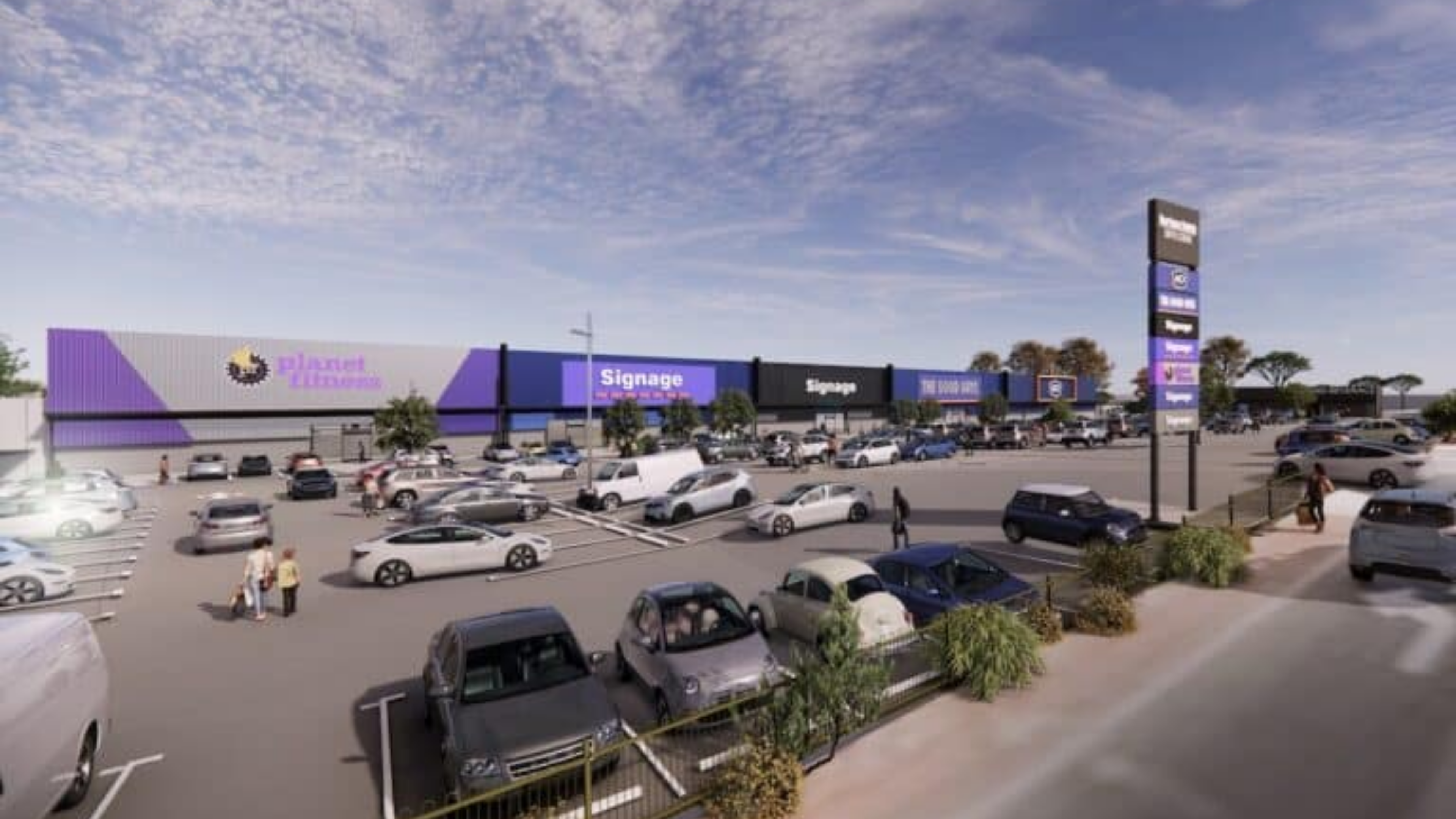 (Image: FDC Construction & Fitout)
When a Vacancy Becomes an Opportunity
The repositioning currently underway at 206-210 Beach Road, Noarlunga Centre, approximately 30 kilometres south of Adelaide's central business district, demonstrates precisely how well-located large format retail assets can maximise these opportunities when a major tenant vacates.
BWP Trust had long held the site as a Bunnings Warehouse property. In early 2023, Bunnings advised that it would vacate the building at lease expiry, relocating to larger, newer premises at the nearby Colonnades Shopping Centre.¹⁰ Rather than selling the vacant building, BWP has commenced a full repositioning of the asset.
The 12,096 square metre building, on a 2.64-hectare site fronting a main arterial road with direct Southern Expressway access, is being reconfigured into five modern showroom tenancies of approximately 1,800sqm.¹⁰ New shopfronts and facades will also be incorporated, along with a fast food pad site, the first in the precinct with direct visibility from the Southern Expressway.¹⁰
The Noarlunga repositioning is instructive on several levels. The underlying land retained substantial value despite the departure of a major anchor tenant, owing to the site's location within an established and growing residential catchment. The flexible floor plate allowed for subdivision into multiple tenancies rather than requiring a single replacement anchor. The addition of a food and beverage pad site reflects the broader trend of large format precincts diversifying their offer to improve traffic and precinct amenity. And the active leasing campaign in a market where well-located space is genuinely scarce points to real occupier demand rather than distressed repositioning.
LFR centres within capital cities typically sit on large tracts of land surrounded by residential development, and therefore provide an alternative use as a development site. This was seen with the 2022 sale of the Crossroads LFR centre in Sydney, which sold for a circa 4% yield but was ultimately an industrial development site with holding income.
Population, Housing, and the Demand That Doesn't Go Away
The structural demand story for large format retail is not complicated. When people move into new homes, they buy things. When they renovate, they buy things. When housing markets recover and residential construction activity increases, the retailers at the heart of large format precincts - hardware, furniture, appliances, floor coverings - are immediate beneficiaries.
Australia's population growth since 2023 has been rapid by historical standards, driven predominantly by net overseas migration.¹² New households are establishing in suburban fringe areas, precisely where large format retail precincts are most commonly located. In the 12 months to mid-2025, household spending on furnishings and household equipment grew 3.7% year-on-year,⁴ supported by a recovering housing market.
Three cuts to the cash rate during 2025 by the Reserve Bank of Australia provided genuine stimulus to housing demand and household confidence, flowing through to retailer sales across the sector. More recently, the RBA has moved in the opposite direction, lifting rates twice in early 2026 in response to renewed inflationary pressure, returning the cash rate to 4.10%.¹³ The resulting uncertainty is worth acknowledging: the interest rate environment is genuinely two-sided at present, and any assessment of the sector's capital market outlook needs to account for the impact of higher debt costs on both buyers and the retailers who occupy these assets.
That said, the supply-side constraint remains the sector's most powerful structural characteristic. Zoned, serviced land in appropriate suburban locations is scarce in most capital cities. The gap between what it costs to build new large format retail and what the market can sustain in rent continues to limit new development. Population growth is running well ahead of new retail floor space delivery, and that imbalance - more people, less new space - tends to resolve in one direction for existing owners: upward pressure on rents and values.
What Owners, Investors and Occupiers Should Be Asking
For those with existing large format retail exposure, the most important question is whether their assets are capturing the market's upward rental movement.
Passing rents across many established precincts reflect lease agreements struck before the current market cycle. The consistent positive leasing spread data across the sector suggests that rental uplifts at renewal are achievable in quality locations. The question is by how much, and relative to what comparable evidence. Investors who rely on stable passing rents as a proxy for current market value may be significantly underestimating both the income potential and the capital value of assets they already own.
The recent sale of HomeCentre Morayfield illustrates the point. The fully leased large format retail centre, located 44 kilometres north of Brisbane, sold off-market for $48 million in January 2026 — acquired by BWP Trust, having last traded for $28.85 million just five years earlier. The sale reflected an initial cap rate of 5.75%, but this tells only part of the story. With several leases due to expire in 2028, the purchaser has identified the potential for rental growth over the short to medium term, meaning the effective yield will rise as passing rents are reset to market. In other words, a sophisticated buyer paid a premium on the previous sale price because it recognised value the passing income didn't reveal: the reversionary upside embedded in below-market leases. For existing owners, the lesson cuts the other way. If that value is visible to an acquirer, it should be visible in your own valuations first.
For prospective investors, the case is grounded in yield, supply scarcity, and population-led demand. The sector's 2025 transaction volumes tell their own story: when institutional capital [DG4] moves at this pace, the re-pricing phase is typically already underway. Quality assets in established locations with strong national tenants are not cheap, and are becoming less so.
For occupiers and tenants, the practical implication is straightforward. Available large format retail space is tightening. In capital city markets, where major precinct vacancy rates are low and new supply is limited, the window for securing preferred locations at favourable terms is narrowing. Early engagement with landlords, and an informed understanding of current market rents, is a practical and commercial advantage.
The Horizon
Large format retail has earned a place at the table of serious commercial property investment in Australia. The sector's fundamentals - durable consumer demand, constrained supply, high underlying land value, a broadening institutional investor base, and a housing-linked income story - are not a product of a single cycle. They reflect structural shifts that have been building since the first homemaker centres opened their doors in the 1970s.
What is different now is that the market recognises it. The institutional money has arrived, transaction volumes are at multi-year highs, and rents are growing. The question for owners and investors is no longer whether large format retail deserves serious attention. It is whether they are positioned to make the most of a market that has quietly stopped being quiet.
Opteon provides independent large format retail valuation and advisory services, drawing on direct market evidence across major precincts nationally.
 Duane Gilliland
Senior Director - National Retail
duane.gilliland@opteonsolutions.com
0476 380 606 
References
Large Format Retail Association (LFRA), Large Format Retail, lfra.com.au, accessed May 2026.
IBISWorld, Large Format Retail Premises in Australia, Industry Report, 2025.
RWC / Commo, Large Format Retail: The Jewel in the Retail Crown?, commo.com.au, March 2025.
Colliers, Australian Retail Snapshot Q3 2025, October 2025.
CBRE, Pacific Market Outlook 2026, 2025. (Construction cost data only.)
The Urban Developer, BWP Trust Rides High on Large Format Retail Momentum, February 2025, citing JLL Retail Transaction Volumes Report 2024.
Knight Frank, Australian Retail Review, 2025/2026, as reported in Smart Property Investment, May 2026.
BWP Trust, H1 FY2026 Earnings Call, ASX Announcement, February 2026.
BWP Trust, Capital Deployment and Equity Raising, ASX Announcement, 6 May 2026.
McGees Property Adelaide / CommercialRealEstate.com.au, 206-210 Beach Road, Noarlunga Centre — Showroom & Bulky Goods Property for Lease, 2024.
BWP Trust, Property Portfolio — Noarlunga, SA, bwptrust.com.au, accessed May 2026.
Australian Bureau of Statistics, National, State and Territory Population, 2024.
Reserve Bank of Australia, Cash Rate Target History, rba.gov.au, accessed May 2026; Savings Mate, Interest Rate History Australia: Every RBA Move from 2020 to 2026, March 2026.
DISCLAIMER
This article is produced by Opteon Property Group Pty Ltd. It is intended to provide general information in summary form on valuation related topics, current at the time of first publication. The contents do not constitute advice and should not be relied upon as such. Formal advice should be sought in particular matters. Opteon’s valuers are qualified, experienced and certified to provide market value valuations of your property. Opteon does not provide accounting, specialist tax or financial advice.
Liability limited by a scheme approved under Professional Standards.